
Title V is a speed limit, not a wall
On September 10, 2026, Wyoming's air quality comment portal carried 37 open items. Two of them were Title V operating permits. The rest were routine construction permits, well pads, compressor stations, production facilities, each one published for public comment, each with a deadline and a county clerk's office where the file could be read. [1]
That count surprises people who are siting power for compute loads, because most of them assume the public-comment part of air permitting starts at Title V. In Wyoming it starts much lower, and knowing where the lines actually sit is most of what permitting strategy is. Title V is a speed limit, not a wall. It does not stop a project. It decides which lane the project drives in, how fast that lane moves, and who gets to watch it go by.
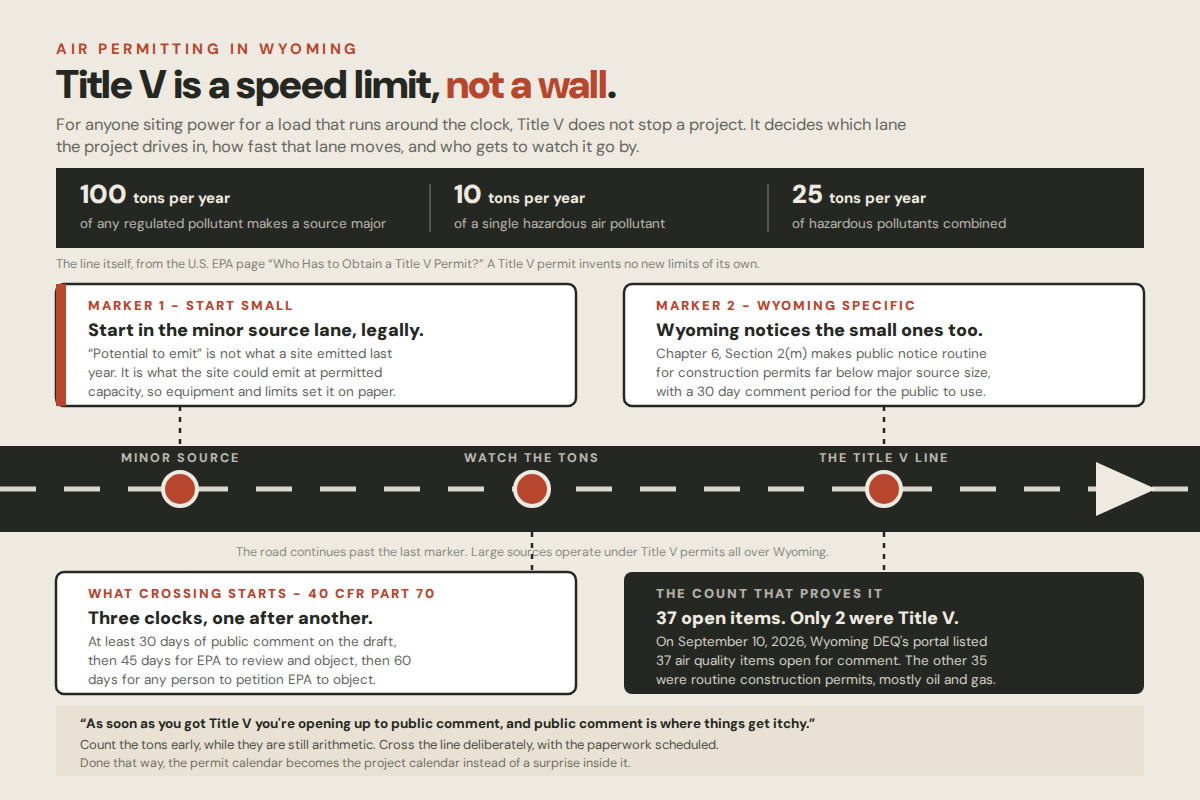
What Title V is. Title V of the Clean Air Act is the federal operating permit program for major sources. A Title V permit does not invent new emission limits of its own. It gathers every air requirement that already applies to a source, federal rules, state rules, earlier construction permits, into one document, adds the monitoring, recordkeeping, and reporting needed to prove compliance, and runs on a fixed five-year term. The U.S. Environmental Protection Agency's own guidance is plain about who needs one: any major source. [2]
A source is major, and needs a Title V operating permit, if it has the potential to emit 100 tons per year or more of any regulated air pollutant, or 10 tons per year of a single hazardous air pollutant, or 25 tons per year of hazardous air pollutants combined.
U.S. EPA, Who Has to Obtain a Title V Permit? [2]
"Potential to emit" is the phrase that does the work. It is not what a site emitted last year. It is what the site could emit running at its permitted capacity, which means it is a number decided on paper, by equipment choices and operating limits, before anything is built. A project team that understands that treats permitting as a design input. A team that doesn't treats it as weather.
What crossing the line starts. A major source does not just file more paper. Its draft permit goes out for public notice and comment. Then it goes to EPA for review. After EPA's review closes, any person may still petition EPA to object. Each step carries its own clock, and the clocks run one after another, not side by side. [3]
Federal rules give the public at least 30 days to comment on a draft Title V permit, give EPA 45 days to review the proposed permit and object if it falls short, and give any person 60 days after EPA's review period ends to petition EPA to object.
40 CFR 70.7(h) and 70.8(c) to (d), the federal Title V permit rules [3]
None of that makes a project impossible. Large sources operate under Title V permits all over Wyoming. What crossing the line changes is the calendar and the audience. Comments must be considered and answered. Objections must be resolved before the permit issues. A project that planned for that road drives it fine. A project that discovers it late has handed its schedule to a process it does not control.
Wyoming notices the small ones too. This is the part that catches people arriving from other states. Wyoming's construction permit rule, Chapter 6, Section 2(m) of the Wyoming Air Quality Standards and Regulations, makes public notice a routine step for construction permits, with a 30-day comment period, at sizes far below anything federal law calls major. A routine oilfield facility permit gets a published notice, a comment deadline, and a file open for inspection, exactly like the count on the portal showed.
On September 10, 2026, Wyoming DEQ's public comment portal listed 37 air quality items open for comment. Two were Title V permits. The rest were ordinary construction permits, most of them routine oil and gas facilities.
Wyoming Department of Environmental Quality, public comment portal, read September 2026 [1]
Other states split this differently, some small-source paths elsewhere carry no comment period at all, so the same site design can be quiet in one state and very public in another. That is why siting is a schedule decision before it is an engineering decision, and why the first permitting question is never "how big can we build?" It is "which lane does this size put us in, here?"
The line we work by. In our own siting research, one sentence does most of the steering: "As soon as you got Title V you're opening up to public comment, and public comment is where things get itchy." The craft that follows from it is unglamorous. Count the tons early, while they are still arithmetic. Let the count help set the site, how much equipment, what operating limits, what the permit will say the site may do, instead of letting the site set the count by accident. Start in the minor-source lane and run legally there. Then, when the load has genuinely grown enough to justify the slower, more public lane, apply for Title V on purpose, with the calendar planned around it. Crossing the line deliberately, with the paperwork scheduled, is a different experience from tripping over it during construction.
A speed limit is not a reason to stay home. It is a reason to learn the road before you pick the vehicle. If you are siting power for a load that runs around the clock, the permit calendar is the project calendar, and the time to learn which lane your site is in is before the first dollar goes into the ground. See how our emissions consulting works.