
Your records know. You can't ask them.
Here is a question, and an answer, from the worked example on our own website: "What did we charge Acme for the March pump repair?" The answer comes back "$480", and underneath it, the part that matters: "Source: Invoice INV-1042, March pump repair, page 2." The site labels that example illustrative, not a client record, and we will keep that label on it here. But the shape of it is the whole subject of this post. The answer was sitting in the business's own paperwork the entire time. Somebody just had to be able to ask. [1]
The answers are already in the building. Tickets, work orders, invoices, manuals, safety docs, specs: a working business writes down nearly everything it later wishes it could remember. What did we charge for that job last spring. When did we last service that unit. What does the manual actually say about this fault. When does the warranty run out. None of those are research questions. They are retrieval questions, and the cost of answering them today is not intelligence: it is digging. The digging lands on a person: the one who remembers which cabinet, which shared drive, which binder, and has forty other things to do.
In most small firms those records live in three places at once: paper in a cabinet, files on a drive nobody organized on purpose, and one person's memory. The first two can be searched by hand, slowly. The third goes home at night, takes vacations, and eventually retires, and every business that runs on it knows the low-grade worry that comes with that. Writing things down was never the problem. The businesses we meet write plenty down. The gap is between "it's in there somewhere" and an answer somebody can act on while the customer is still on the phone.
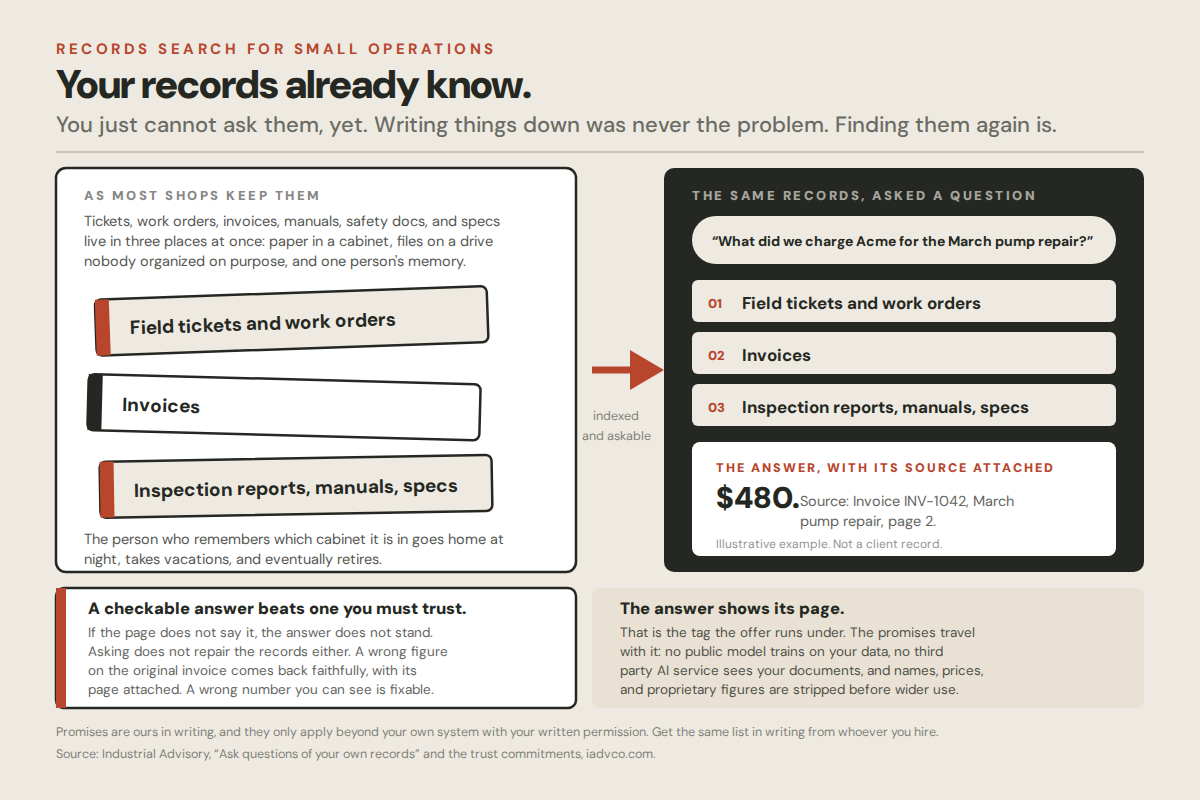
One honest limit belongs here too. Asking your records questions does not repair the records. If the figure on the original invoice was wrong, a good answer will faithfully report the wrong figure, with its page attached, which is how you find out. That is still progress: a wrong number you can see is fixable, and a wrong number nobody can find again just keeps quietly costing money.
What changes when the records can be asked. Our first offer is exactly that worked example, made real on a client's own documents: "a search box that answers from your documents and shows you the exact page it came from."
Tickets, work orders, invoices, manuals, safety docs, specs, a search box that answers from your documents and shows you the exact page it came from.
Industrial Advisory, Ask questions of your own records, iadvco.com [1]
"What did we charge Acme for the March pump repair?", "$480." Source: Invoice INV-1042, March pump repair, page 2. (Illustrative example. Not a client record.)
Industrial Advisory, worked example, iadvco.com [1]
An answer you can check beats an answer you have to trust. This is a design choice, not a technology limit, and it is the one to hold every vendor to. A system that answers from your records should show the page the answer came from, every time, so a human can verify it in seconds. If the page doesn't say it, the answer doesn't stand. The moment an answer arrives without its page, you are back to trusting, and trusting a confident tone is how wrong figures end up in quotes, invoices, and filings. Citation is what turns a clever demo into a tool a business can run on.
Make any vendor promise these things, in writing, including us. The demo is the easy part. The promises that matter are about your paper. Ours are printed on our site, and they are the list we would hand a competitor's customer too: answers show their sources. Your documents never train a public model. No third-party AI service ever sees your documents. And names, prices, and proprietary figures are stripped before anything is used beyond your own system, only with your written permission.
No public model trains on your data. No third-party AI service ever sees your documents. We strip customer names, prices, and proprietary figures before anything is ever used beyond your own system, and only with your written permission.
Industrial Advisory, trust commitments, iadvco.com [2]
Get those in writing from whoever you hire. A vendor who will demo for an hour but won't put the data promises on paper has told you which half of the deal they take seriously.
The next time the phone rings with a question your own paperwork already answered, what we charged, when we were there last, what the spec requires, the cheap version of that moment is not a bigger filing cabinet or a better memory. It is records you can ask, that answer with the page attached. See how records search works.