
One question, four small specialists, and a rulebook: how a working AI setup is actually built
An emissions test does not announce its failure in advance. On a battery of industrial oilfield engines, the drift shows up months earlier in the trend - an exhaust temperature creeping up, a fuel number sliding out of line - and the operator who asks "which of my engines is heading for a failed test" is asking a fair question that no single big model answers well. The question is not hard because it needs a smarter machine. It is hard because it takes several different kinds of answer at once, plus a set of rules somebody wrote down. A working AI setup is a stack, not a model, and the stack has a shape worth drawing.
The question goes in at the top. A person asks a plain question: which engines are drifting toward a failed test, or which invoices are about to need chasing. One coordinating model takes the question and plans the work - which records to pull, which predictions to call for - and at the end it explains what came back. Planning and explaining are what a large general model is good at. Making the measurements is not its job.
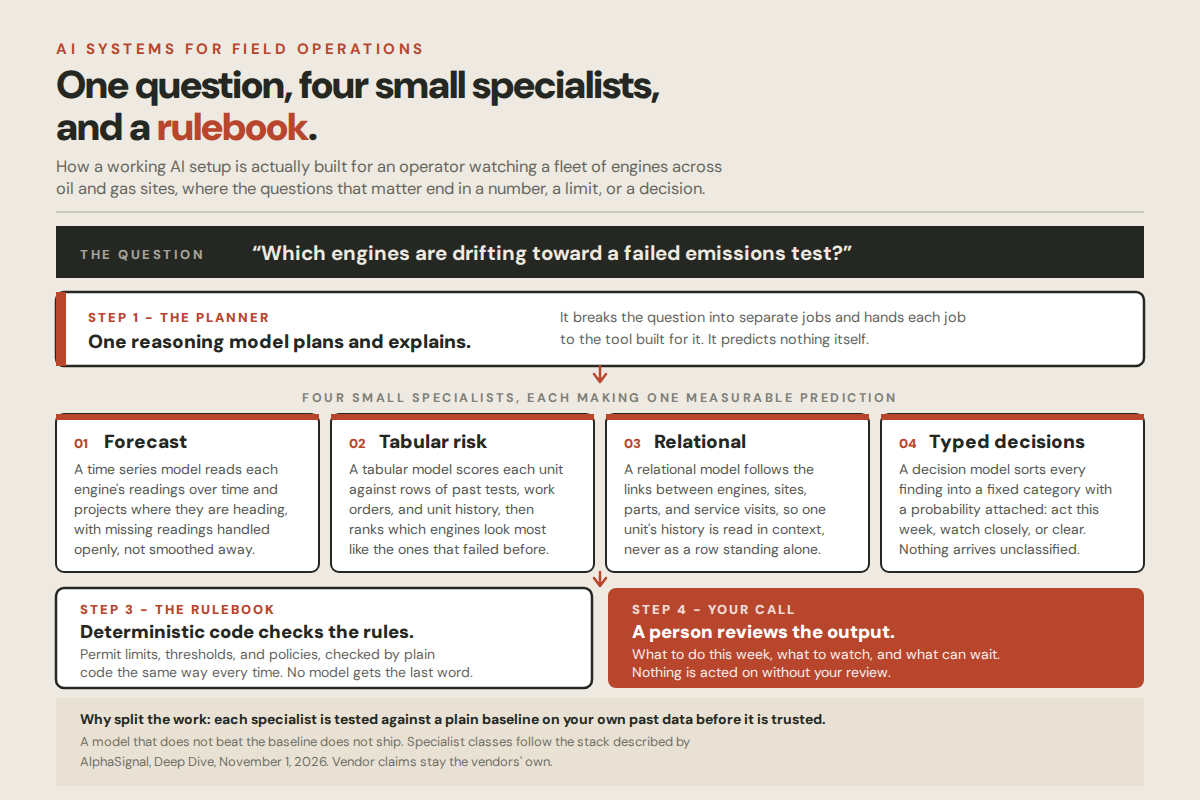
The specialists each return one measurable answer. The middle of the picture is a row of small models, each built for exactly one kind of prediction, and each returning an answer that can be scored:
- The forecast specialist reads a series of numbers over time and says where it is heading. Mistral's Timestral is the current example: Mistral's model card describes a family of zero-shot forecasting models up to 209M parameters that accept up to 32,768 time steps of history and return a range of outcomes across 21 quantiles, and Mistral reports the largest version leading three public forecasting benchmarks. For the engine question, it carries the trend: where each tracked number will sit at the next test. Missing readings are handled openly, not smoothed away. - The tabular specialist makes a risk call off rows and columns. Prior Labs describes TabPFN as a foundation model that predicts from a table in a single pass - classification or regression off the same checkpoint, trained on synthetic tabular tasks. For the engine, it carries the risk score: how closely this engine's readings match a failing pattern. For the engine example, the tabular model scores each unit against past tests, work orders, and unit history, then ranks which look most like engines that failed before. - The relational specialist answers across linked records. NVIDIA's documentation describes Kumo Relational as a foundation model that produces predictions over multi-table data without a task-specific model being trained first. It carries the history: this engine's service and permit records, and what they say about how it has been run. The relational model follows the links between engines, sites, parts, and service visits, so a unit's history is read in context rather than as a row standing alone. - The typed-decision specialist returns a decision with a probability attached, not a paragraph. TypeSafe's Jev produces typed judgments that software can act on directly. It carries the routing call: what kind of finding this is and where it goes next. The decision model puts every finding into a fixed category with a probability attached: act this week, watch closely, or clear.
The rulebook is plain code, and it is the load-bearing part. Under the specialists sits a layer nobody calls AI: deterministic code that checks the rules. The permit limits are written down; the code reads them, not a model. Whether a projected number crosses a limit is arithmetic, and arithmetic does not take votes. This is what makes the stack trustworthy instead of merely impressive - every check can be read and replayed on demand. A model may raise a flag; the code decides whether the flag is real.
A person reads it before anything acts. The picture ends where every honest system ends - a person reviewing the output before it acts on anything. The coordinator writes up what the specialists found and what the rules say; the person reads the result and decides. Nothing in the stack acts on its own output. The reviewed report separates what to do this week, what to watch, and what can wait.
Worked example one: the engines. The question goes in - which engines are drifting toward a failed emissions test. The forecast specialist carries the time series and projects each tracked number to the next test date. The tabular specialist scores which engines' readings match the failing pattern. The relational specialist pulls each engine's service and permit history. The decision specialist routes the findings. And the rulebook holds the permit limits in code: a projected number over a limit is a flag regardless of how confident any model sounds. The output is a short report - which engine, which number, how far it is drifting, what the permit says - and a person decides what happens next.
Worked example two: the invoices. Same shape, office version. The question is which invoices are about to need chasing. The relational specialist carries the records: who owes what, and how long it has sat. The tabular specialist scores which open invoices match the late pattern. The rulebook holds the follow-up policy in code - how often a reminder may go out and what it may say - and the decision specialist picks the kind of nudge. The coordinator drafts the follow-up; a person reads and approves it before anything sends.
Why the stack beats one big model. Each piece is checkable: a forecast can be scored against what actually happened, a rule in code can be read, a routing call can be audited. Each piece is replaceable: a better forecast model next year slots into the same shape without rebuilding the rest. And the expensive model only does the two jobs it is best at - planning and explaining - while the measurements come from small models built for exactly those measurements. The AlphaSignal deep dive that prompted this post describes the same shift from the vendor side: specialized foundation models handling defined analytical tasks, paired with a reasoning model, instead of one large model doing everything. The AlphaSignal deep dive was dated November 1, 2026.
The honest cost. A stack is more parts to maintain than one model, and the coordinator can still misread a specialist's answer - which is exactly why the rules sit outside the model and a person reads the result. The architecture is not a promise of correctness. Each specialist is tested against a plain baseline on your own past data before it is trusted. A model that does not beat the baseline does not ship. It is a promise that every step can be checked, and that is the version worth building.
If the system you are being quoted is one big model doing every job, the stack sketch is part of the review.
Sources
- AlphaSignal - "Why Specialized Foundation Models Could Reshape the AI Stack," Sunday Deep Dive, 2026 - https://alphasignal.ai
- Mistral AI - Timestral-209M model card, Hugging Face - https://huggingface.co/mistralai/Timestral-209M
- Prior Labs - tabpfn_3_5 model card, Hugging Face - https://huggingface.co/Prior-Labs/tabpfn_3_5
- NVIDIA - Kumo Relational overview, Structured Data and Graph Models docs - https://docs.nvidia.com/sdgm/kumo-relational/about-kumo-relational/overview
- TypeSafe - System One and Jev documentation - https://docs.typesafe.ai
- Industrial Advisory - iadvco.com - https://iadvco.com